Blogs
What's New Trending
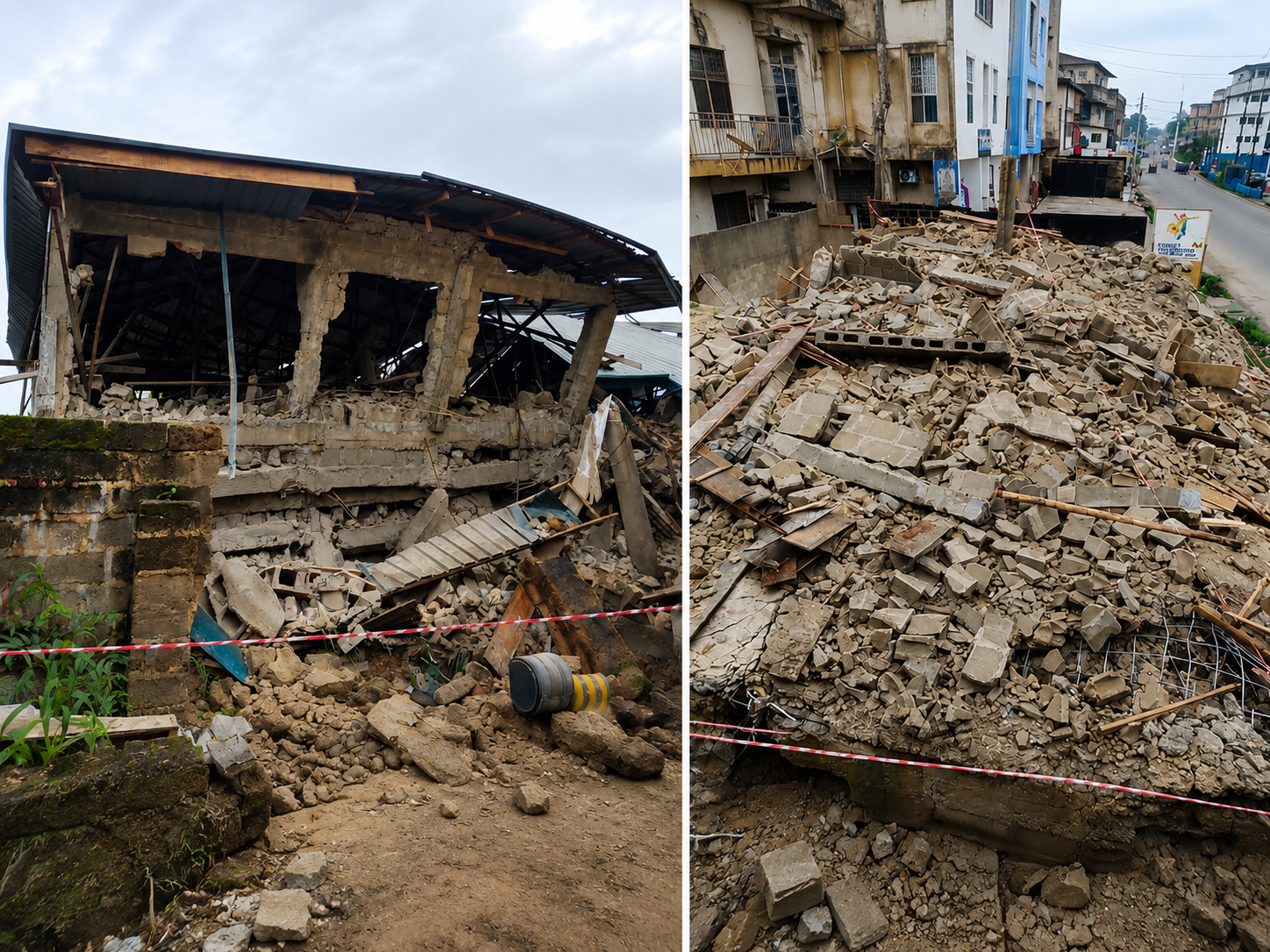

Nigeria’s rainy season has become more than just a period of flooding and erosion. It has increasingly exposed the consequences of poor construction practices, weak regulatory compliance and inadequate site preparation. Every year, heavy rainfall places enormous stress on buildings whose foundations, drainage systems or structural components were never designed to withstand prolonged exposure to water.
For homeowners, businesses and property developers, these incidents are sobering reminders that quality construction is not a luxury—it is a necessity that protects lives, investments and communities.
At Blue Iroko, every project begins with one guiding principle: a building must be safe long before it is beautiful.
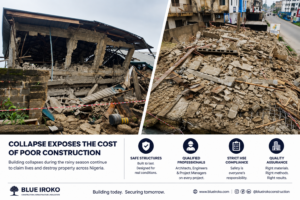
Abia State has witnessed several building collapse incidents over the years, many occurring after periods of intense rainfall.
In July 2025, an uncompleted three-storey building collapsed at the Low-Cost Housing Estate in Umuahia. Although there were no fatalities, nearby residents, including a nursing mother and her baby, sustained injuries. The Abia State Government immediately launched an investigation, sealed the site and ordered structural integrity tests on adjoining buildings. (The Guardian Nigeria)
Earlier, in June 2022, part of a three-storey building at Ahiaeke, Umuahia North, collapsed after a heavy downpour. Reports suggested prolonged exposure to the elements and concerns about substandard construction materials contributed to the failure. Thankfully, no lives were lost. (Punch Newspapers)
An even more tragic incident occurred in Aba in 2019, where two separate three-storey buildings collapsed following torrential rainfall. One building reportedly failed because persistent waterlogging weakened its foundation, while another uncompleted structure was linked to poor-quality construction materials. The incidents claimed lives and left others trapped beneath the rubble. (The Guardian Nigeria)
Similar stories have unfolded across Nigeria.
In Mushin, Lagos, a newly completed two-storey building collapsed after heavy rainfall in July 2024. Emergency responders rescued several trapped occupants, while authorities revealed that the structure had previously been marked for structural assessment. (NEMA Nigeria)
These incidents demonstrate a recurring pattern: rain rarely causes buildings to collapse by itself. Instead, rainfall exposes weaknesses that already exist within a building’s design, construction or maintenance. (NEMA Nigeria)
Heavy rainfall affects buildings in several ways:
For buildings already compromised by poor workmanship or substandard materials, persistent rainfall simply accelerates the inevitable.
Recognising these risks, the Abia State Government recently introduced compulsory soil and geotechnical testing for new building approvals in Umuahia as part of broader measures to strengthen construction standards and prevent future building failures. The state has also established a structural integrity testing facility to improve compliance and public safety. (FMINFO)
One of the biggest misconceptions in the construction industry is that strong buildings are achieved simply by using more cement or thicker reinforcement.
In reality, durable structures result from a combination of:
When even one of these elements is ignored, the safety of the entire building can be compromised.
At Blue Iroko, we believe every building should be designed to withstand not only today’s conditions but also tomorrow’s environmental challenges. Our construction philosophy is built on professionalism, quality assurance, regulatory compliance and an uncompromising commitment to Health, Safety and Environment (HSE) standards.
Rather than viewing safety as an item on a checklist, we integrate it into every phase of project delivery—from site selection and design to construction, inspection and handover.
Many building failures begin long before the first block is laid. Without understanding the nature of the soil, groundwater conditions and drainage characteristics, even a well-designed structure can develop serious structural defects over time.
This is why Blue Iroko prioritises:
These investigations enable our professionals to determine the appropriate foundation type and structural system suitable for each location.
Successful construction requires collaboration among trained professionals.
Blue Iroko executes projects using qualified and experienced:
Every discipline contributes to ensuring that buildings are structurally sound, functionally efficient and fully compliant with applicable standards.
This multidisciplinary approach significantly reduces construction risks while improving project quality and longevity.
Blue Iroko recognises that compliance with professional and regulatory standards is essential for safe construction.
Accordingly, our projects are executed in line with relevant Nigerian regulations and professional best practices, including:
Compliance with these standards helps ensure buildings meet structural, environmental and safety requirements throughout their lifespan.
Construction remains one of the world’s highest-risk industries.
Blue Iroko therefore maintains a strong safety culture by implementing internationally recognised HSE principles across all project sites.
Our safety practices include:
Every worker is expected to understand that safety is everyone’s responsibility.
Protecting lives is as important as completing projects on schedule.
Building quality cannot be inspected into a project after completion—it must be built into every stage of construction.
Blue Iroko maintains strict quality assurance procedures by:
This systematic quality control process ensures projects meet both engineering specifications and client expectations.
Nigeria’s increasingly intense rainfall demands smarter construction practices.
Blue Iroko incorporates climate-resilient solutions such as:
These measures improve the resilience of buildings against flooding, erosion and prolonged exposure to heavy rainfall.
Property owners also have important responsibilities in maintaining safe buildings.
Blue Iroko recommends:
Early intervention often prevents costly repairs and, more importantly, saves lives.
Nigeria’s recurring building collapse incidents serve as powerful reminders that quality construction is never accidental. It is the product of careful planning, professional expertise, strict supervision and unwavering adherence to safety standards.
At Blue Iroko, we remain committed to delivering projects that are not only aesthetically impressive but also structurally sound, environmentally responsible and built to stand the test of time.
Every project reflects our belief that excellence in construction begins with doing the right thing—even when no one is watching.
Whether developing residential, commercial or institutional projects, Blue Iroko continues to invest in best practices, qualified professionals and modern construction methods that protect lives, safeguard investments and contribute to safer communities across Nigeria.